
Guigoz Gest milk is formulated with starch to thicken its texture in the baby’s stomach. This formulation choice has a direct consequence on feeding equipment: a standard slow-flow nipple does not allow a denser milk to pass through properly. The flow rate, the shape of the opening, and the material of the nipple then become parameters to consider before purchase.
Variable flow and opening: the technical parameters of a nipple for thickened milk
The main recommendation for Guigoz Gest is to use a variable flow nipple. This type of nipple has a slit (often in the shape of a cross or star) instead of a round hole. The slit opens proportionally to the baby’s sucking strength, allowing the thickened milk to flow without the infant having to exert excessive effort.
A round hole nipple, even in flow rates 2 or 3, can partially clog with a milk containing starch. The baby becomes exhausted, swallows air to compensate, and the digestive issues that Guigoz Gest is supposed to alleviate may worsen. The slit opening eliminates this mechanical problem.
To choose a Guigoz nipple on Poupala, the variable flow criterion remains the primary selection filter, before brand or shape.
Comparison of nipple types for thickened milk
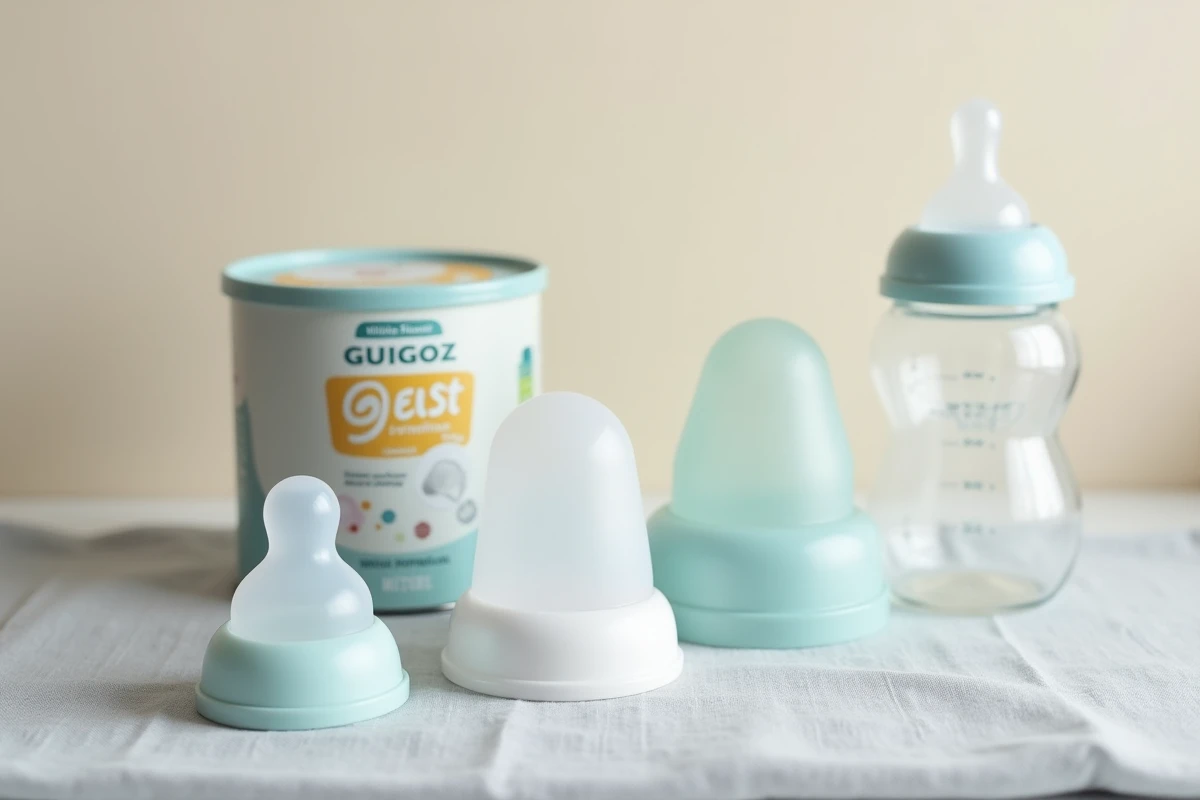
Not all nipples are equal when it comes to milk containing starch. The table below summarizes the differences between the main configurations available in pharmacies and supermarkets.
| Type of opening | Shape | Suitable for thickened milk | Risk of blockage |
|---|---|---|---|
| Round hole (flow 1-2) | Classic | No | High |
| Round hole (flow 3) | Classic | Partially | Moderate |
| Cross slit | Variable | Yes | Low |
| Star slit | Variable | Yes | Low |
Slit nipples (cross or star) are the only ones that guarantee a steady flow without forcing the baby. Flow rate 3 with a round hole works in some cases, but it remains a compromise: if the milk cools or if the preparation is slightly more concentrated, blockage may occur during feeding.
Silicone or rubber: which material for Guigoz Gest
Silicone nipples dominate the market. They are transparent, tasteless, and withstand repeated sterilizations well. Natural rubber (latex), being softer, offers a texture closer to the mother’s breast, which can facilitate the transition for some babies.
With thickened milk, the material plays a often underestimated role. Silicone retains its shape better after several weeks of use, which is relevant when the slit needs to remain calibrated. Rubber, being softer, can deform and gradually widen the opening, changing the flow rate unpredictably.
- Silicone is suitable for the majority of babies fed with thickened milk, thanks to its controlled rigidity and durability.
- Rubber should be favored if the baby categorically refuses the silicone nipple, but the frequency of replacement must be increased.
- In both cases, checking the condition of the slit before each use remains a habit to adopt: a deformed nipple alters the flow rate and can cause choking.

Nipple size according to age and stage of Guigoz Gest
Guigoz Gest is available in first age formula (from birth) and second age (after six months). The viscosity may vary slightly between the two. The size of the nipple should follow the baby’s age, not just the type of milk.
A newborn has a weaker suck than a five-month-old infant. Even with a variable flow nipple, size influences the amount of milk delivered by sucking. Manufacturers generally offer numbered sizes:
- Size 1 (birth to three months): suitable for the first bottles of Guigoz Gest first age, with a slit that limits the maximum flow.
- Size 2 (three to six months): the slit opens more under stronger sucking, which accompanies the baby’s growth.
- Size 3 (six months and older): intended for the transition to Guigoz Gest second age, with a wider flow for sometimes slightly denser milk.
However, each baby has their own sucking rhythm. Observing the duration of the feeding is the best indicator: if a bottle consistently takes more than twenty minutes, the flow is probably insufficient. If the baby coughs or milk runs down the sides, it is too fast.
Maintenance of nipples used with starch-based milk
The starch present in Guigoz Gest leaves residues in the nipple’s slit after each bottle. A quick rinse is not always enough to remove these deposits. Without thorough cleaning, the slit gradually narrows and the flow decreases from one bottle to the next.
After each feeding, turning the nipple inside out and rinsing it under hot water while squeezing the base helps dislodge the starch stuck in the opening. A fine brush or a dedicated cleaning needle complements this action for stubborn cases. Replacing the nipple every four to six weeks remains the safest recommendation with thickened milk, regardless of the material.
The choice of a nipple for Guigoz Gest comes down to one central parameter: the slit opening, which absorbs variations in milk viscosity without blocking the flow. The material, size, and frequency of replacement refine this choice, but without an appropriate slit, the other criteria lose their relevance.