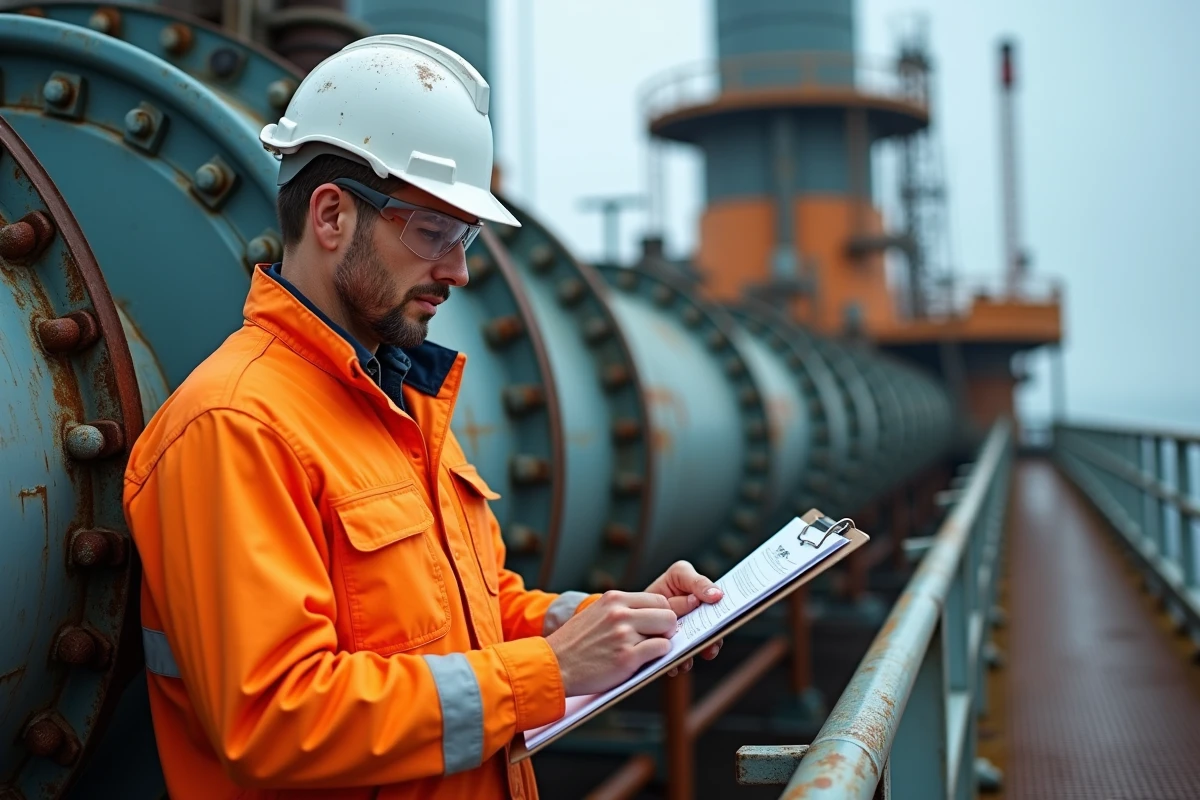
On an offshore TotalEnergies platform, the boundary between production jobs and maintenance jobs structures the entire organization of work. Understanding this distinction allows for targeting the right training pathway and anticipating the daily operational reality, far from generic summaries that confuse offshore environments with onshore refining sites.
Outdoor Operator on an Oil Platform: An Underestimated Technical Position
The outdoor operator (or production operator) is the backbone of a platform. Their role is not limited to “monitoring screens”: they physically maneuver valves, control oil-gas-water separators, and adjust pressure parameters in real-time to maintain operational continuity.
TotalEnergies requires a Bac to Bac+2 in industrial fields for this position, complemented by an Operator Certificate or a Training in Oil Industrial Operations (FOIP). This entry filter dispels the misconception that motivation alone would suffice to get on board. Without these prerequisites, an application simply does not pass the initial screening.
Those wishing to explore the various pathways available to work on a Total oil platform will find that the position of outdoor operator remains the main entry point for non-engineering technical profiles.
On rotation, the outdoor operator works in shifts (often in 3×8). Each handover requires a detailed briefing: equipment status, reported anomalies, specific safety instructions. A handover error can lead to a complete production shutdown.

Offshore Maintenance: Industrial Electricians and Automation Engineers at the Heart of Operations
Competing articles often summarize the platform to a few production roles. The reality of recruitment shows a massive need for maintenance profiles, particularly for industrial electricians and automation engineers.
An offshore industrial electrician works on high-voltage systems, distribution panels, and pumping motors that operate continuously. The slightest electrical failure on an isolated platform at sea cannot be resolved by calling an outside contractor: the technician on board must diagnose and repair within a constrained timeframe.
The automation engineer manages the control-command systems (DCS, SCADA) that drive the entire process. When a pressure sensor drifts or a control loop desynchronizes, it is they who recalibrate the system before the situation escalates into an emergency shutdown.
Discriminating Skills at Hiring
- High voltage electrical certifications (H1V, H2V) and knowledge of ATEX standards, mandatory in explosive risk areas
- Proficiency in at least one DCS system (Honeywell, Emerson DeltaV, or Yokogawa) for automation engineers, as each platform uses a specific software environment
- BOSIET certification (Basic Offshore Safety Induction and Emergency Training), a common prerequisite for all offshore embarkations, regardless of the position
- Operational technical English, as manufacturer documentation and safety procedures are written in English on TotalEnergies installations
Offshore Platform and Refining: Two Environments Confused by Job Offers
Working on an oil platform and working in a refinery are distinct professions. On the platform, the goal is the extraction and primary separation of hydrocarbons. In a refinery (like the TotalEnergies site in Donges), crude oil is transformed into fuels, asphalts, or petrochemical bases through catalytic reforming, cracking, or distillation units.
An industrial performance engineer in a refinery optimizes conversion yields. An offshore drilling engineer designs well trajectories and manages bottom pressures. The skills, risks, and work rhythms have almost nothing in common.
This confusion extends to search engines, where queries about oil platform jobs return offers in onshore petrochemicals. We recommend systematically filtering job postings by the keyword “offshore” and checking the actual assignment location before applying.

Daily Life Offshore: What the Rotation Rhythm Changes Concretely
The most common rotation system at TotalEnergies remains two weeks on duty, two weeks off. In some remote areas, the cycle extends to four weeks on site followed by four weeks off.
During the embarked period, the day is organized around the work shift (usually twelve hours), communal meals, and rest time in shared or individual cabins depending on seniority. Onboard catering offers four meals a day, a point that partially compensates for the isolation and total lack of external social life.
Constraints Rarely Mentioned in Job Descriptions
Access to phone and internet remains limited and often charged. Personal communications occur during restricted time slots. This constraint weighs more heavily on duration than the work rhythm itself.
The noise is constant. Production equipment, compressors, and ventilation systems generate a noise level that requires continuous hearing protection in process areas. Sleep in a cabin, even one that is properly soundproofed, never reaches the quality of rest on land.
The platform manager (OIM, Offshore Installation Manager) bears the legal and operational responsibility for the entire installation. Their authority supersedes any directive from land regarding safety. This position requires several years of offshore production experience and specific regulatory certification.
Working on a TotalEnergies oil platform means accepting a living environment where every action is procedural and every anomaly documented. Those who thrive sustainably in this environment are those who find their rhythm in this rigor, not those who come solely for the remuneration.